• Home
    • Make/r Space
    • Spatial Design Services
    • Vision Lab
    • Intentional Spacemaking™ (NYC)
    • The Spatial Pivot Plan Course (digital)
    • On Intentional Spacemaking
    • About
    • Contact
Menu

Spatial Medium

Street Address
City, State, Zip
Phone Number
a Design + Strategy studio

Your Custom Text Here

Spatial Medium

  • Home
  • Services
    • Make/r Space
    • Spatial Design Services
    • Vision Lab
  • Events + Offerings
    • Intentional Spacemaking™ (NYC)
    • The Spatial Pivot Plan Course (digital)
  • Blog
    • On Intentional Spacemaking
  • Connect
    • About
    • Contact

12 Days of Spacemaking: Day 6

December 15, 2021 Spatial Medium

(noun)

- basic training or instruction in a subject
- a therapeutic technique that involves doing activities that “ground” or electrically reconnect you to the earth (also called earthing)
- a reference point in an electrical circuit from which voltages are measured
- a common return path for electrical current


Ooooo, ooooo, oooo - Day 6!

Grounding. Oh boy...get ready for metaphors!

First, let's talk about grounding in the architectural world. Mostly, it is discussed when we are talking about the electrical scope of a project. You may already know that your outlets in a bathroom or kitchen need to be grounded (or GFCI outlets - Ground-Fault Circuit Interrupter) because of the proximity of water. Should the outlet get wet or the appliance fall into water, the GFCI will indicate there is an overload of "hot" current and will shut off the power, protecting you from electrical shock and/or fire. To get the outlet functioning again, you'll need to hit the reset button. Here is a photo and diagram of what that looks like:

gfci-outlet.jpg
0614.jpg

Nerdy, right? I know, isn't it great?!

Here's the thing...that GFCI outlet that you have in your home is just like you. There is information coming in on a daily basis (your external influences) and there is information that you put out in the world (your responses and actions). Depending on how much energy is coming in, we could "overload" and default to shut down. Circuit tripped. No more function. Time to reset. Anyone out there feel like this happens on the regular? Me, too. So today, I'd like to chat about how we ground ourselves and investigate what that space looks like.

As we just found out, grounding for an outlet means that there is a safe pathway to release excess (or hot) electricity.

Unsurprisingly, grounding in alternative medicine means that you “ground” or electrically reconnect yourself back to the earth. Think about walking in the grass barefoot or sitting against a tree. Reconnecting with nature directly.

The way that I think about grounding is a bit of a blend between the two with one major adjustment...

I think of grounding as an interior spatial shift back to your own earth/source, whatever that means for you.


Let me explain...

On day 4, we talked about reflection and I mentioned that one of my home-based reflection spaces is my meditation space. For some people, meditation is a perfect space for grounding. And I understand why, I feel very centered when I meditate regularly. However, I know that when things in my life become stressful or chaotic, my meditation practice is the first to go. I don't intend to let it go but I find it challenging to sit when things around me feel like they're falling apart.

What grounds me back to my earth/source is movement in space, not a physical space itself. I need to feel my body moving, my energy connecting to nature, my breath moving inside me alongside others, or my brain being stimulated with ideas bigger than me in order for me to return to myself.

As a result, my go-to grounding spaces are often bodies of water, the forest, my yoga community, and witnessing art installations that manipulate space in some way (sound, movement, light, etc).

What I just realized this week is that I intuitively hold representation of my grounding spaces when I meditate. In the picture below you'll see some pieces I've collected over time that tuck into my palm when I sit and breathe:

- a pink quartz stone for self- and community-compassion
- a piece of incense from an art installation (it was given to me with permission, I promise!)
- a grey stone from the shore of Puget Sound with full view of the majestic Mt. Rainier
- an aquamarine stone for supporting communication with myself and others

It makes me even more sure that we all carry specific grounding requirements in us - what works for one will not work for the other. And I truly believe that you inherently know what grounds you, even if it is not a conscious thought as of yet.


Let's go in reverse for a second. If we can figure out the non-spatial items we need to ground ourselves, then we can access these in more physical spaces than just our home or a specific destination.

This is valuable to understand if the place that you feel the most grounded is no longer accessible to you because you've moved or a childhood home was sold, etc. Which, for many of us, is something we felt acutely in 2020. With everything shut down, our systems for grounding often disappeared suddenly and completely. And my guess is that most people are still trying to figure out how to get back to that space, that center, for themselves.


So maybe this will help.

Now, I realize that even though our goal with this series is to create space, many of you may not have the actual space to participate fully at the moment. That's ok! These emails will always be here for you to return to and maybe something will sink in even without you knowing it. However, if there is any day to take a minute to do the journal prompts, let it be today.

See if you can dedicate 5 minutes to document how you ground yourself. Make a voice memo or jot it down on the back of a receipt. It is probably simpler and more inherent than you think. Or take little moments to experiment - kick off those shoes and walk in the grass! Take a bath or shower in the middle of a busy day! And then see if you can integrate it in the smallest form when/if you need to during the next few weeks - regardless of location or environment.


You have grounded space inside you ready to be reset; this I truly believe. 


JOURNAL PROMPTS

  • Take a deep breath and think about the last time you felt grounded. What senses were stimulated? Were you in motion or still? Surrounded by nature or art? With people or solo? List out anything that comes to you and just observe.

  • What tends to go first when you are un-grounded? Is it exercise? Healthy eating? Reaching out to friends? (This often gives me a clue that I need to pre-ground, before I get the default shut down.)

  • What is one little step you can take to ground yourself? Mine is moving my body every day. It could be as simple as touching your toes and letting out a deep breath.

  • How can you support creating space for grounding in your life?


This wraps Day 6...thank you for taking time to explore spacemaking from a place of grounding!

If you feel inspired to share any takeaways, examples in your own home, or questions that came up for you, please access any Spatial Medium social media account. Please be sure to add #12daysofspacemaking and tag @spatialmedium so I can see what you post.

Source: www.spatialmedium.com/on-intentional-space...

12 Days of Spacemaking: Day 5

December 13, 2021 Spatial Medium

(noun)

- a relationship in which a person, thing, or idea is linked or associated with something else
- the action of linking one thing with another


Well, hello, Day 5! It's all about connection today, friends.

Connection in the architectural environment could mean any matter of things:

- how circulation pathways bridge different areas of a space
- how materials are consistent throughout to give continuity as you move between different spaces
- how the hidden mechanical, electrical, and plumbing (MEP systems) marry seamlessly with the visible design elements
- the built material details (like how a kitchen backsplash meets with a window sill interruption)
- the way that space can be designed to support the end-user/community

Now, I could give you a month-long masterclass on the first four points above. But then you would all be on your way to becoming architects! And you didn't sign up for 12 Days of Architect-ing. This is about creating space. So let's just focus on the last point.

How can creating space for connection support the end-user/community?


To be honest, this is why Spatial Medium came into existence. I had been working in the architectural industry for a few years and was seeing a pattern - architects/firms were ignoring the end-user needs/values/stories/journeys. At the time I was working in the healthcare sector and it was incredibly heartbreaking. I believed, and still do, that the best design is the one that takes into account the end-user needs. Using healthcare as an example, this means creating space that supports the nurses working on the floor and the patients healing in their care. Too many times their stories and journeys were ignored - or disconnected - which made for ineffective, and often unusable, design.

So today, I'm going to give you different examples on creating space for connection through design.


CONNECTION TO COMMUNITY

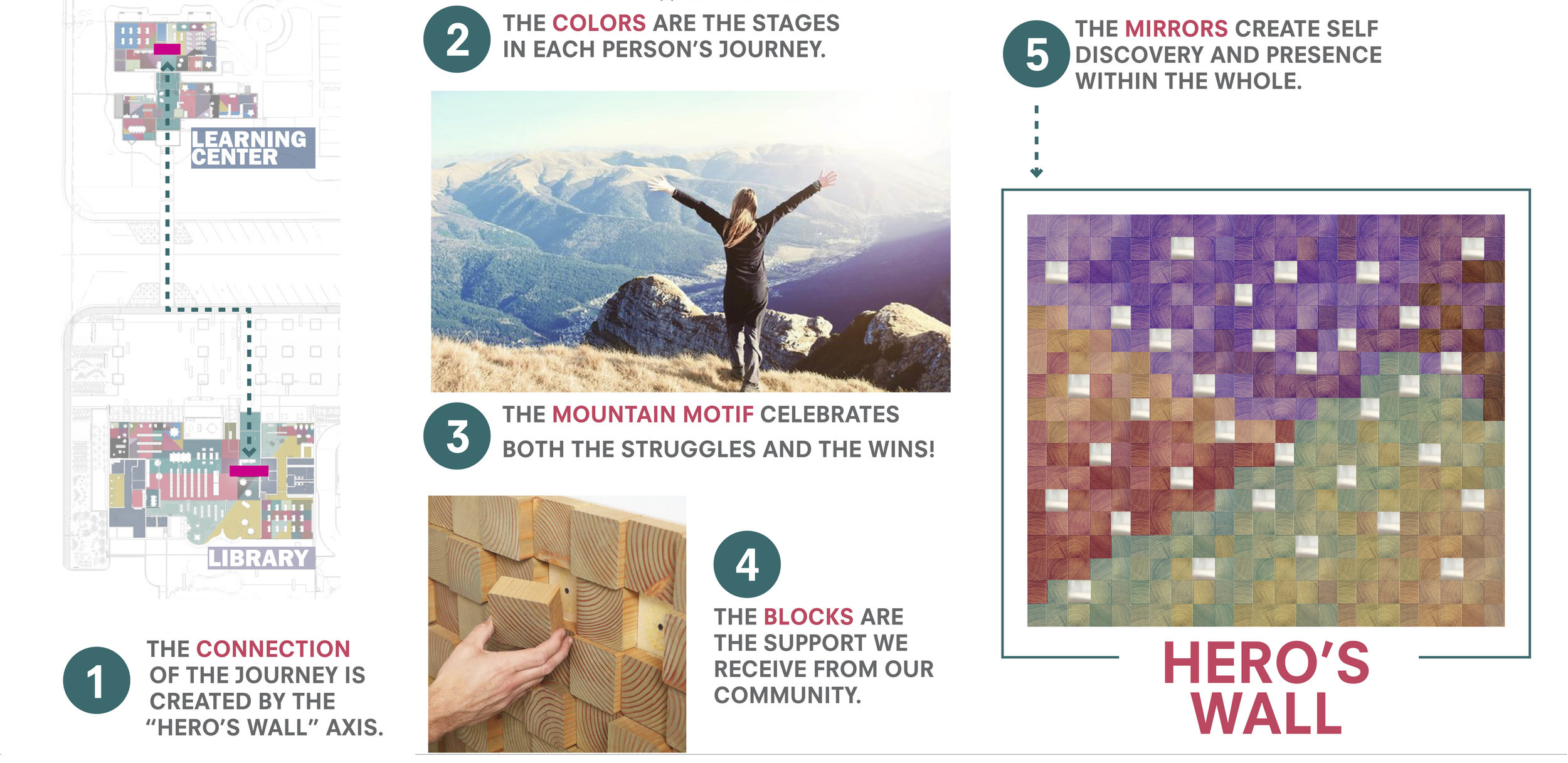
Mesquite Library and community resides just outside of Las Vegas, NV. This project required connecting an old library structure to the new library structure across a busy street. The old library was to house a focused business learning center while the new library would cater to all services with a kids and teens area, a cafe, and community space.

After working with the community to find out what their values and goals were, a clear theme came forward: many wanted a space to be able to learn, create new skills, and design a better future for themselves and their families. To reflect this desire, I proposed a design based on the "hero's journey".

Via Wikipedia, "the hero's journey involves a hero/person who goes on an adventure, is victorious in a decisive crisis, and comes home changed or transformed. In my mind, this is what the community was facing". Changing your life is no easy task and there would be challenges and pitfalls along the way. I wanted to create something that would remind them that they were all on this journey together. As a result, the Hero's Wall was born.

The Hero's Wall lived in both the Learning Center as well as the main Library. While the physical connection was not possible because of the street in between, the Hero's Wall lived at the entrance in both of those buildings providing a sculptural and poetic connection between the spaces. It was constructed of individual wood blocks (representing the support we receive from community) stained in various colors (representing the different stages in each person's journey) with mirrors placed among the blocks (representing self-discovery and presence within the whole). Now, every time someone is welcomed to the space, they are connected back to the community as well as their own personal journey.

Image courtesy of Simpson Coulter Studio


CONNECTION TO MISSION

Arche shoes wanted to bring a younger clientele into their beautifully crafted line of leather shoes and bags. A family-owned company that had been around for ages, the goal was to retain the loyalty of the existing customers while appealing to a new group.

Before presenting a design scheme, research and study was applied to the business itself. The family-owned story and dedication to craftsmanship was deeply important to the brand; a connection to earth and natural elements was essential to product development; and luxury and sophistication was at the core of everything.

The result? An entire retail showroom deeply connected to mission and customer awareness. A sophisticated showroom grounded in wood forms flowing from floor to bench to shelf and back again. Glass panels illustrating family and entrepreneurial journey. And a simple display platform that allowed changing colors via light gels and suede platform toppers as the seasons, and products, shifted.

arche_from+kramer.jpg
arche.jpg

You may be thinking "well, that's wonderful, but I do not have have end-users to think about here - it's just me!". And you'd be right...sort of.

In your lives, you and whomever you live or interact with are the end-users. And if I communicate anything to you in these 12 days, it's that you CAN create space to support you in any manner of ways, connection being one of them.

I design for connection in my space at every turn. It's probably my signature characteristic, to be honest. Almost all of my furniture is re-purposed; from a grandparent's old kitchen table to my meditation cushion, I prioritize connecting to my past, present, and future. I find strength in these somewhat small connections every time I pass them in my space. Let me give you an example of creating space for connection that may be more relatable.


CONNECTION TO LEGACY

As I mentioned, I enjoy re-purposing old items from my family (and in general!). I love giving something a second, third, or fourth life. One object that I am particularly proud of is the installation I made from my grandmother's piano.

My grandmother, Renae, was a wonderful pianist and visiting her home was always marked by sitting at the piano, touching the keys, listening to her play. She lit up when she was at the piano and had sheets (and books and folders and magazines and more sheets...) of music piled everywhere. It was glorious.

When she passed, her piano was severely out of tune and unable to be repaired. There was talk of donating it to a nursing home, however, the sentiment was that they would just trash it. I couldn’t bear the thought of this item that she had cherished, touched, shared with her entire family just disappear. So, I asked if I could take it apart and make something new, hopefully preserving the tactile memory and spirit of this sweet woman. In other words, I wanted to create something to remain connected to her life.

While the installation above is not a room or physical space, it creates the space of connection because of what it is, what it means to me, and how it came to be. It serves me, the end-user, because it reminds me of where I come from and points me to where I want to go. And while it's not a new guest room wing or renovated bathroom, it helps create the space I want to live in with my ancestors, in my home, and in community with others.

In what ways can creating space for connection be a supportive gesture for you, your legacy or mission, or your community?


A coda before we get into the prompts if you will allow me...

As in the examples above, connection takes a bit of effort in order to understand your/individual/community needs; reflect that understanding; and honor it in the spaces you create. It doesn't have to be much as there are many different ways of extending connection. Perhaps listening deeper (to yourself or others). Or simply acknowledging a difference of opinion.


JOURNAL PROMPTS

  • What comes up when you think about connection, particularly to yourself?

  • How does connection look/feel/sound in your life right now with your public space? With your relationships?

  • Where does a connection feel weak, like it needs a bit more attention?

  • How can you support or celebrate your connections more in your day-to-day? It doesn't have to be grand...think small.

  • In what ways, physical and intangible, can you make space for more connection in your life? This could be to yourself, your circle of loved ones, or your community. Observe as you go about your day.


This wraps Day 5...thank you for taking time to explore spacemaking from a place of connection!

If you feel inspired to share any takeaways, examples in your own home, or questions that came up for you, please access any Spatial Medium social media account. Please be sure to add #12daysofspacemaking and tag @spatialmedium so I can see what you post.

Source: www.spatialmedium.com/on-intentional-space...

12 Days of Spacemaking: Day 4

December 12, 2021 Spatial Medium

(noun)

- the throwing back by a body or surface of light, heat, or sound without absorbing it; - a thing that is a consequence of or arises from something else;

- serious thought or consideration.


Get cozy, friends, Day 4 is all about reflection!

Mmmmm, this is probably one of my favorite of this series. Reflection can mean so many different things in space, in life, in us. Let's take a look...

When I think about creating reflection in physical space I think of it in two ways;

1) bouncing light throughout to illuminate and
2) defining a dedicated space for feeling, thinking, or analyzing.

All of my favorite things!

Take a look at the photo below and pay attention to the mirror in the background. My studio apartment sits back from the street a bit because there is a full apartment in front of mine. Luckily, the way this building was created gives me a front window that extends out a bit from the front apartment exterior wall to allow for some "direct" street light. I say "direct" because there is nothing blocking it, however, because it sits back from the street, it does tend to stay darker, particularly in the winter. I do have two other windows in the main space but they face the building next door - I can almost touch my neighbor's exterior wall if I go out on my fire escape. Light still comes through but not in abundance. Placing the mirror high on the wall allows for me to take advantage of a bit more light reflecting back into the main space where it can typically feel a little darker than the front room.


Now let's take a look at making a dedicated space for reflection. I may be unconventional in my thinking here, but I don't believe that you need 4 walls and a door to create a dedicated space. I believe all you need is an intention and a bit of creativity.

My space for reflection is tucked directly between my kitchen table and my desk/workspace. It simply consists of a cushion on the floor with my growing collection of plants adjacent. Over the years, I've experimented with various locations for my reflection space and, as strange as it seems, I like this one best. The cushion on the floor allows me to ignore any items or clutter I may have on my table or desk. The proximity of plants connect me to nature and the stand doubles as a place for candles and incense. And with my back against the wall, I have a view of my entire apartment. It feels like a powerful and safe place to allow myself to become vulnerable as I journal or meditate.

Where/how do you prefer to reflect?  What does it sound/look/feel like?


If you don't have a reflection practice but are interested in building one, please know, it does not have to conform to a space or framework, it can be where and what you make it to be. I have many reflection practices that are not tied to my home space. I take walks and hit record on my voice app to have a loving conversation with myself when I need to work out disjointed thoughts in my head. A lot of times, even without me realizing it, reflection happens when I am mid-swim or run. Most interestingly, I have a friend who prioritizes reflection in her bathroom - she installed a waterproof notebook and pen for writing any thoughts that come to her in the shower!


A DAY FOR PAUSE

Every 4th day we will take a moment to pause the journal prompts.

Some of the themes we talk about can be difficult to process and may bring up feelings that take a minute to work through. If learning how to create space is the goal, let's be intentional and build in some space for absorbing, looking back, and taking pause.

For today there will be no journal prompts, just a reminder to make space to breathe and regroup. If you feel moved, please hit reply and let me know how things are going for you!


This wraps Day 4...thank you for taking time to explore spacemaking from a place of reflection!

If you feel inspired to share any takeaways, examples in your own home, or questions that came up for you, please access any Spatial Medium social media account. Please be sure to add #12daysofspacemaking and tag @spatialmedium so I can see what you post.

Source: www.spatialmedium.com/on-intentional-space...
← Newer Posts Older Posts →

copyright 2025 spatial medium