• Home
    • Make/r Space
    • Spatial Design Services
    • Vision Lab
    • Intentional Spacemaking™ (NYC)
    • The Spatial Pivot Plan Course (digital)
    • On Intentional Spacemaking
    • About
    • Contact
Menu

Spatial Medium

Street Address
City, State, Zip
Phone Number
a Design + Strategy studio

Your Custom Text Here

Spatial Medium

  • Home
  • Services
    • Make/r Space
    • Spatial Design Services
    • Vision Lab
  • Events + Offerings
    • Intentional Spacemaking™ (NYC)
    • The Spatial Pivot Plan Course (digital)
  • Blog
    • On Intentional Spacemaking
  • Connect
    • About
    • Contact

12 Days of Spacemaking: Day 3

December 11, 2021 Spatial Medium

(noun) - a fault, blemish, or undesirable feature; the state of being faulty or incomplete


Now, I know what you're thinking..."yuck, imperfection?!? No thanks!"

Ahhhh. I see you. And yet...

What would happen if you allowed yourself to make space for imperfection in your life?  Would it open up space for something else to exist/thrive? 


Let me walk you through ways I make space for - and often celebrate - imperfection.

In the image below you'll see a brownish/mustard armchair. (If you've been here the last few days, it's just on the other side of the "bedroom" in the "living room"...) It's of the vintage variety and is rather comfortable if I do say so myself. However, it came to me as an imperfect object. Actually, it came to me as a non-functioning chair. Let's see how making space for imperfection let me acquire one of my favorite, and most used, chairs...

I first saw this chair in an old co-working space storage unit. It was part of a myriad of items that were tagged for the dumpster. It had one very ornate, victorian wooden legs missing and was incredibly dusty after years of banishment. Maybe it's the caretaker in me or my fierce belief that I can re-use every.broken.thing. but I took one look at it and said "I'll take it!".

When I got it home I examined the legs again. They were very detailed and unless I wanted to spend time, energy, and money, I would not be reconstructing them anytime soon. Even though I had a hunch the chair would be imperfectly perfect for my studio space and lifestyle, I wasn't absolutely sure so I decided to experiment with it.

I looked around my apartment to see what could be used to prop the seat level, assuming that I would have to shimmy something underneath to get the correct height. Miracle upon miracles, the wood crates I had stacked as my bookshelf along with the existing wooden peg leg connection on the chair made for a very level, very sturdy, and very comfortable seat!

Would it have been the end of the world if I had passed on the chair? No. I would have found something at some point. But I adore that by making space for imperfection I gave this piece second life, freed up my brain to focus on other things, and - bonus - created a unique wood-crate-bookshelf-chair piece!


Now, let's talk about some intangible moments as well. Like just this week, in fact!

I've been posting the landing page for this email engagement in a few different communities of mine. I have to admit, sharing my thoughts and ideas is not super comfortable for me and each time I hit send I tend to run around the apartment to release the nervous energy I feel. I promised myself when I first had the idea for the 12 Days that I would view it as an experiment...I knew I would fumble and mis-step and mess up. I'm not super tech-savvy and I moved pretty quickly from idea to implementation on this digital-heavy offering. The chance for imperfection was high.

Yesterday morning I received a gentle and helpful nudge that I had a typo in my copy. And honestly, it was a pretty glaring typo, one I should have noticed. Directly on the heels of that I realized that I had set up my email opt-in incorrectly and it was causing issues. I had to laugh in that very moment as I knew Day 3 was about to focus on Imperfection - and here I was, demonstrating it beautifully!

For many years, I've been afraid of the imperfect side of sharing ideas - the typos or missteps, unintentionally causing harm, or simply not being able to aptly communicate my thoughts. It isn't the only thing that stops me from taking action but it certainly contributes. I'm so grateful that the imperfection gremlin has quieted enough to allow me to test, experiment, and offer what I can to the world. Typos and mistakes included!

What would you create, share, or make space for if imperfection had a cozy home in your day-to-day? 


One last bit on imperfection before we end...embracing imperfection in others.

Have you ever found yourself critical of someone else because they did not do something the way you thought it should be done, the "perfect" way? It could be a partner, a boss or colleague, a random person you encounter in your day, or even a business interaction. The fact that they mess up or drop the ball annoys you, if only they did x-y-z!

I personally bump up against this all the time and I'm guessing I'm not alone. It always takes me a minute to realize that the level of perfection I am holding them to is the level of perfection I'm holding for myself. Meaning, if I'm not giving them grace in a moment of imperfection, I'm certainly not giving myself grace in those moments either. And we could certainly all use a bit more grace.

This shifted my relationship to imperfection and while it is a continuous, imperfect practice for me (see how that works?!?), it has helped release a fair amount of agitation in my day-to-day...which frees up so much space!

How would your engagement with the world around you change if you embraced imperfection in yourself and others?


JOURNAL PROMPTS

  • What comes up when you think about imperfection? Is there negative or positive connotation?

  • How does imperfection look/feel/sound in your life right now?

  • Where do you feel you can invite imperfection in, even if just a little bit?

  • When do you tend to strive for perfection the most? And what would happen if you gave yourself permission to be imperfect in that moment?

  • In what ways, physical and intangible, can you make space for imperfection in your life? (Do not throw this computer! It's a gentle nudge to observe and see what comes up...:)


This wraps Day 3...thank you for taking time to explore spacemaking from a place of imperfection!

If you feel inspired to share any takeaways, examples in your own home, or questions that came up for you, please access any Spatial Medium social media account. Please be sure to add #12daysofspacemaking and tag @spatialmedium so I can see what you post.

Source: www.spatialmedium.com/on-intentional-space...

12 Days of Spacemaking: Day 2

December 10, 2021 Spatial Medium

(noun) - something that indicates or fixes a limit or extent


Oh boy, day 2 and already in the thick of it! Boundary. Yikes!

Let's keep it simple and talk about physical boundaries first, shall we?

Physical boundaries are really easy to see and experience - there are solid walls, glass walls or glazing, movable partitions, fences, and a myriad of hybrid combinations. These affect how we sense space, what access is allowed, and the way we communicate. For example, a solid wall will keep light/vision/smell/access at bay but depending on how it is constructed, may allow unwanted sound through. Conversely, a neighbors fence may deny access or define property while still allowing for communication, senses, and connection between inhabitants.

Let's take another look at the main space in my studio for two quick DIY examples in the photo below.

The first, as you may recall, is that I created a fixed boundary with the bedframe/sofa combo between my "bedroom" and my "living room". Obviously they are in the same physical space but the delineation helps me organize my life. The item that I didn't talk about before is the lamp - it is strategically placed to reiterate the "invisible wall" that I've created between the "bedroom" and "living room". Because of it's height, it helps me to visually understand the "rooms" as separate.

The second is the movable green curtain boundary between my "living space" and my "work space". Again, they are technically in the same open room, however, the simple act of pulling the curtain shuts my brain off for the night. And that is invaluable.

And then there are the physical boundaries that are implied. What does this mean exactly?

The photo below is a picture I took of the Lakeside Skating Rink in Prospect Park one winter day. You can see the large roof overhang that protects the sheltered skating rink below. What I want you to pay attention to is the line where the snow disappears, almost directly mirroring the roof overhang above. This is what I consider to be an implied boundary. There is nothing to stop sound/smell/vision/light/access, technically everything is still outside. However, and especially with the presence of precipitation, you can clearly see that the group arriving will be within the space of the skating shelter in a few paces.


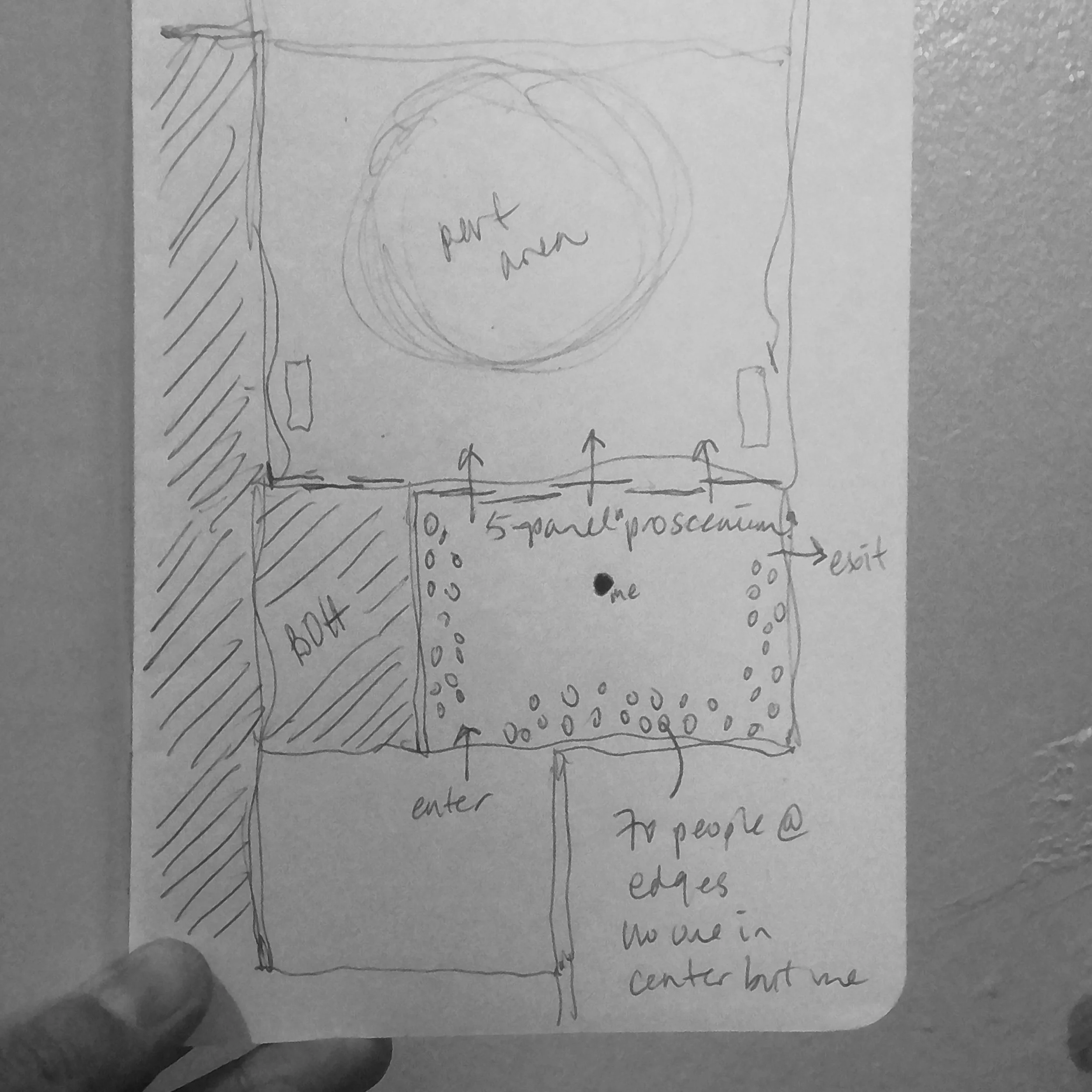
People impose implied physical boundaries in space as well. I recently attended an art performance at The Shed in NYC and experienced a waiting period prior to top of show. There was a "lobby" space provided for people to wait and I watched as about 70 people filtered in behind me over the course of 30 minutes. I say "behind me" because as I was walking around in center of the space, each person (or group of people) kept to the walls. Clearly they felt that the middle of the space was not for them even though there were no rules that said you could not be in the middle. It was fascinating to witness, almost as much as the performance itself, and I had to document it in the plan diagram* below!

Pay attention to your surroundings this week - do you move through any implied boundaries?  Do you participate in socially implied boundaries or do you, like me, completely buck the trend?  Simply observe...and delight in it.


(*A plan is like a birds-eye-view or a map of the spaces. It is typically cut at 4'-0" above the floor line to include door openings, etc. Mine is more diagrammatic so I've utilized single lines and text for clarity.)


Ah now. Personal boundaries. Deep breath, stay with me here.

As opposed to the physical boundaries, personal boundaries are sometimes not clearly visible (although they can be...example, a close talker encroaching your physical space). If you are anything like me, personal boundaries can be challenging to create, practice, and uphold. But with the holiday season in full swing and the potential for boundaries to be pushed (or ignored completely) I believe it's important to nudge them into the light.


[A quick note: if talking about personal boundaries is new to you, here is a good resource I've found to explain them. I am not a trained therapist so please consult a licensed professional if you are struggling with creating healthy boundaries. Mine is personally on speed dial.]


I find that my personal, intangible boundaries are easier to achieve when I attach a physical, spatial component to them. It doesn't have to be much. Maybe a moment to take a quiet breath and ground yourself outside. A dark room to de-sensitize to avoid overwhelm. A sprint down the block to shake loose clarity on expressing your needs. Perhaps volunteering to take a drive and grab that forgotten ingredient to regroup before company arrives. I find that keeping my hands busy so my body has an outlet for agitated energy helps a lot.

Regardless of what creating and holding personal boundaries consists of for you, please know that it is a practice. Just like our physical needs and spaces, they will shift and change as you shift and change. Be kind to yourself this holiday season. One more deep breath...


JOURNAL PROMPTS

  • What does creating boundary mean to you? Is it primarily physical or intangible? When is it both?

  • How does creating a new boundary look/feel/sound in your life right now?

  • Where do you feel you need to revisit your boundaries?

  • When do you tend to ignore, diminish, or remove your boundaries? Observe as you go about your day.

  • In what ways, physical and intangible, can you make space for healthier boundaries in your life? (This could mean a shift in your physical space, an expression of your needs, or getting curious about expectations.)


This wraps Day 2...thank you for taking time to explore spacemaking from a place of boundary!

If you feel inspired to share any takeaways, examples in your own home, or questions that came up for you, please access any Spatial Medium social media account. Please be sure to add #12daysofspacemaking and tag @spatialmedium so I can see what you post.

Source: www.spatialmedium.com/on-intentional-space...

12 Days of Spacemaking: Day 1

December 9, 2021 Spatial Medium

(noun) - a thing that bears the weight of something; a source of encouragement or comfort

(verb) - hold up; give assistance to; enable to function or act; be capable of sustaining; suggest the truth of


Welcome, I'm so happy you're here! The theme for today is support and it is chosen intentionally to begin our series as it will be an umbrella for every day that follows.

In physical space, support generally refers to the structure of something, like a column holding up the floor plate above. Or perhaps a piece of mechanical equipment that supports a function like AC or heat exchange. Pretty self explanatory and easy to follow the trail.

But I would posit that there are other ways that your physical space can support you. It might not seem as linear of a connection, but it is there.

The decisions we make in where we place items in our homes, what type of conditions we create for habits/routines, how we access things...all of these can be made by design (aka spacemaking!). And if support is at the crux of it, well, you have a space that provides ease to your day-to-day instead of creating challenges or roadblocks.

When you begin to look at space as a partner in supporting your day-to-day, you can begin to see how things shift to more sustainable - and flexible - solutions.

Decisions become a little easier because if it isn't supportive, it doesn't get implemented. Exploration is embraced as a way to understand the pulse of what you need, even if it changes (and it will!). Speaking of change, it isn't feared because you know to get curious in order to get back to a place of support. Re-framing design this way allows you to personalize and customize spacemaking to your needs. In other words, it allows space to be supportive.

This is where I want to start our series, with this notion of supporting your day-to-day through the design of your spaces, whether they be physical or intangible.

Do you have an area of your home or workspace that you don't use very often? Or maybe don't like very much? Or aren't sure what to do with it at all?!

Do you have habits that you want to create or be more consistent with? Dreams that keep getting derailed? Projects that continuously start/stop??

When I find myself not using a part of the very precious 350 sqft in my apartment or stumbling on the way to building a habit/routine, I get curious as to why. Perhaps it's because my life goals have shifted a bit and I'm not reflecting that in my space. Perhaps it's because I've outgrown the previous supportive environment and need to expand. Perhaps I'm not providing ease for habit/routine building to take hold. Let me give you a few examples...

The photo above is the main room of my studio apartment. Small spaces, like boats, must function efficiently and do triple duty in most cases. So to say that this space is designed to support me is, well, an understatement. Let me walk you through three intentional moves I made to support my day-to-day. Some where made immediately and have not changed. Others have developed over time. Each began with the driving intention for support.

Gathering friends: The bed was placed strategically as soon as I moved in to allow for a living area at the front near the entry (I am standing in the entry vestibule). I value having a place to gather people as connecting with others supports my spirit and it was important to achieve that even in this small space. If I wanted to really place priority on gathering, I would invest in a murphy bed system so I could convert this entire room into a more public space and maybe that will shift in the future. But for the moment, I have no qualms about the realities of the public/private blend in a studio apartment - this is Brooklyn after all! (Bonus: this bed placement also supports my energy by giving me full view of the door while still providing a "barrier" between me and any intruder or negativity*.)

Reducing stress/barriers: You may note the bike storage pole on the left - this allows me to keep my bike safe and dry while not taking up valuable floor space. I became tired of moving my bike around the apartment during the day. If it was sitting in front of my piano, it would be a barrier to playing that day. Clearly, I needed to shift something. Having this "home" for my bike removes the stress of figuring out where it will go, gives me zero excuses for other activities in the home, and supports my desire to be mobile at the blink of an eye.

Desire to expand into my dreams: Lastly, in the back left you will see a closet with a small desk inside it. When I first moved in, I used it as a clothes closet. That didn't feel quite right and I switched it be a creative storage closet (for architectural samples, project docs, etc). That wasn't utilized in the way I was hoping and felt stagnant - I rarely went over there and didn't use it for anything but object keeping. So I shifted it again, this time to a supportive space for focused work/recording/etc. While it is taking longer to build-out (mostly in habit - let's face it, the space is only so big!), the fact that it is visible and ready supports my long-term life vision and keeps me tethered to my dreams. It is a daily reminder to keep going, even if I'm not fully there yet.

(*This is a strategy borrowed from feng shui, a traditional practice originating in ancient China.)


My relationship to space is deeply ingrained in how I see and move through the world. I play with it, rely on it for support, and create it for others to make their lives better.

My hope for the 12 Days of Spacemaking is that it gets you thinking about space in a new way...and maybe even inspires you to play, rely on, and create as well. 


Each day moving forward, the prompt will be another way you can design support into your physical (and non-physical) spaces. Perhaps a few will resonate. Maybe others will inspire you to shift your space(s). Hopefully all will expand how you see and create space a little bit, both in your personal home and out in the world.

Now that you've heard and seen examples of how space can be a partner in supporting your day-to-day and even your future dreams, it's your turn!


JOURNAL PROMPTS

  • What does support mean to you? Is it primarily physical or intangible? When is it both?

  • where does support begin for you (in physcial or intangible space)?

  • Name the ways (1) you support yourself, (2) others support you, (3) your space supports you. How does support look/feel/sound in your life right now?

  • When do you accept/ask for support and when do you resist it? Observe as you go about your day.

  • In what ways, physical and intangible, can you make space for more support in your life? (This could mean a shift in your physical space, an ask for help, or getting curious about providing your own support.)


This wraps Day 1...thank you for taking time to explore spacemaking from a place of support!

If you feel inspired to share any takeaways, examples in your own home, or questions that came up for you, please access any Spatial Medium social media account. Please be sure to add #12daysofspacemaking and tag @spatialmedium so I can see what you post.
Source: www.spatialmedium.com/on-intentional-space...
← Newer Posts Older Posts →

copyright 2025 spatial medium